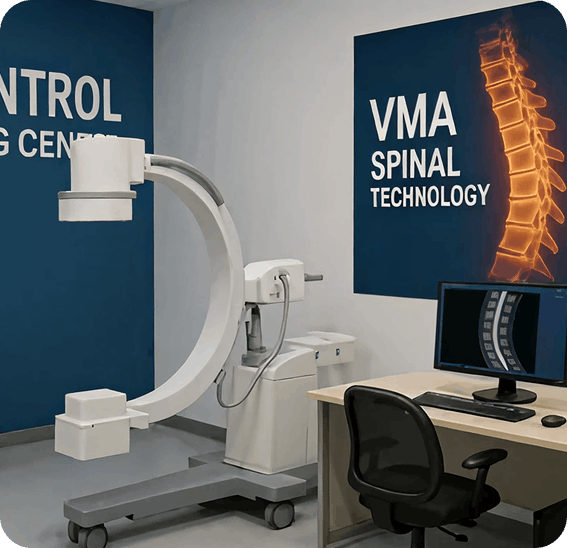

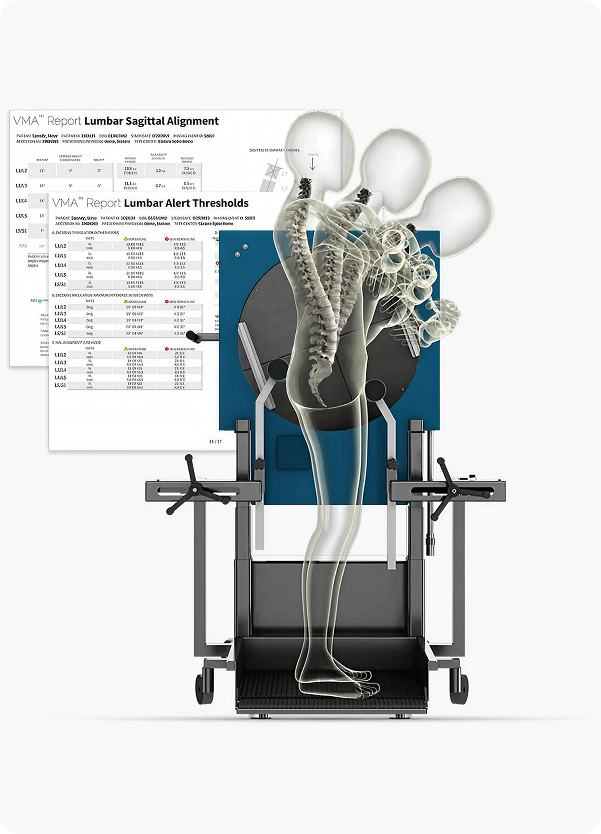

VMA® Where Spinal Motion Imaging Becomes Objective Data
VERTEBRAL MOTION ANALYSIS (VMA®)
What Traditional Imaging Can’t Show
Why Motion Changes Everything
Motion Revealed
Objective Measurement
FDA Cleared
Documented Motion
Measuring spinal motion under controlled conditions provides objective data that can complement static imaging and support clearer documentation.
Built for Consistent Measurement
Repeatable, Quantified Motion Imaging
VMA® is designed to produce repeatable spinal motion measurements using controlled imaging protocols and quantitative analysis. By combining reliable test–retest performance, sub-millimeter and sub-degree measurement accuracy, and FDA-cleared motion-based imaging, VMA® supports consistent evaluation of spinal motion across patients and time.
Repeatable
Reliable motion measurements
0.5mm
Translation accuracy
0.2°
Rotation accuracy
FDA
Cleared motion imaging
From Motion to Medical Evidence
A Report Designed to Support Clinical and Legal Review
Each VMA® study generates a motion-based report that presents quantified spinal motion measurements using standardized protocols to support clinical and legal review.
-
1
Quantified Motion Data
Each report presents measured intervertebral rotation and translation derived from frame-by-frame motion analysis under controlled imaging conditions. -
2
Configurable Thresholds
Providers can configure visual threshold indicators to highlight selected motion values within the report for easier review and interpretation. -
3
Documented Motion Evidence
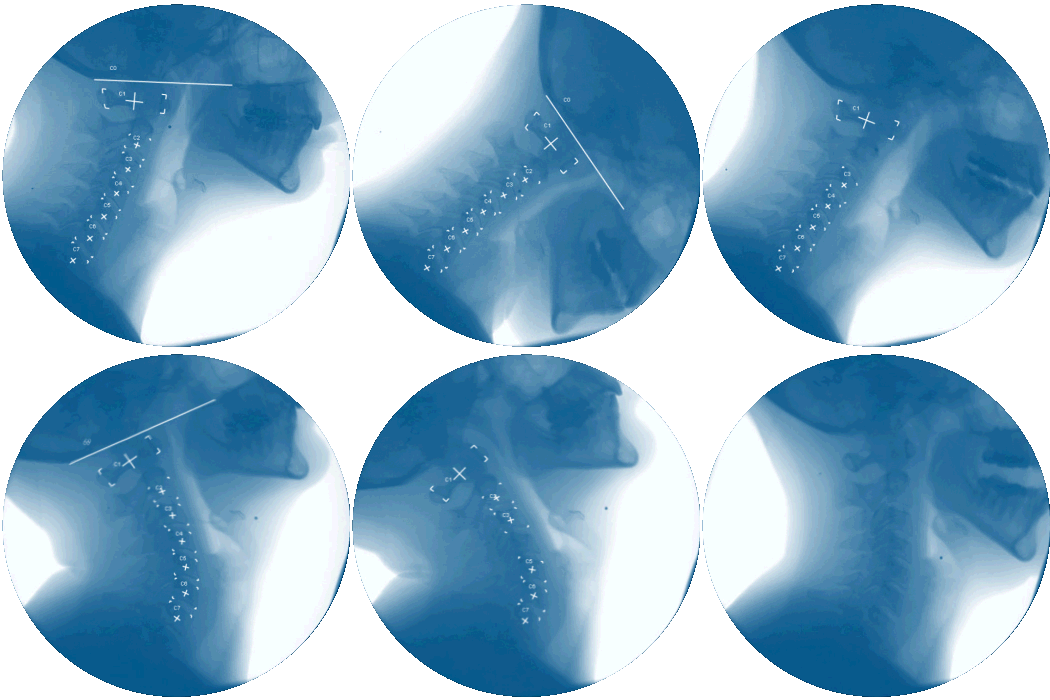
Motion measurements are displayed alongside corresponding imaging frames to support transparent documentation of observed spinal motion patterns. -
4
Structured for Review
Standardized report structure and verified motion measurements are designed to support consistent clinical and legal review of spinal motion findings.
What Changes When You Control the Imaging Process
When Imaging Stays In-Office
Imaging Control
Standardized imaging protocols remain fully within your practice.
Patients Stay In-Office
In-Office imaging keeps patients engaged and returning.
Financial Control
Reduce imaging costs while capturing imaging revenue.
Workflow Integration
Imaging integrates seamlessly into existing clinical workflows.
Keeping imaging in-office improves control, continuity, and operational efficiency.
The Business Impact of Imaging Ownership
Why Imaging Ownership Compounds Value
Owning advanced imaging infrastructure creates opportunities beyond single-location care. Practices may choose to deploy VMA® across multiple clinics, establish dedicated imaging centers, or expand into new territories through structured imaging ownership models. With options such as area-based placement strategies and multi-system deployment, imaging ownership can support long-term growth strategies focused on scale, operational leverage, and the creation of durable, multi-location imaging enterprises designed to serve patients, partners, and future generations.
Chosen by Practices That Lead in Spine Care
Why Leading Providers Choose Driving Force
Having this type of technology is very impressive
Brett Favre
Designation goes here
The first time we can really see the spine move ... it’s the technology of the future
Dr. Nancy Snyderman
Designation goes here
Elementra truly stands out. Their modern facility and caring professionals make every visit smooth and stress-free. I finally feel like my health is in trusted, capable hands.
Emily Johnson
Austin, TX
At Elementra, I’m more than just a patient. Their commitment to quality care and genuine compassion has made a huge difference in my overall health and peace of mind.
Sophia Martinez
Miami, FL
Elementra provides exceptional service with a human touch. From the front desk to the doctors, everyone is kind and professional. I always leave feeling better and more informed.
James Anderson
New York, NY
Choosing Elementra was the best decision for my family. Their friendly, efficient, and compassionate team makes quality healthcare simple, accessible, and easy to manage.
Olivia Brown
Denver, CO
Lorem ipsum dolor sit amet, consectetur adipiscing elit, sed do eiusmod tempor incididunt ut labore et dolore magna aliqua. Quis ipsum suspendisse ultrices gravida. Risus commodo viverra maecenas accumsan lacus vel facilisis.
Joseph L.Mabie
Influencer
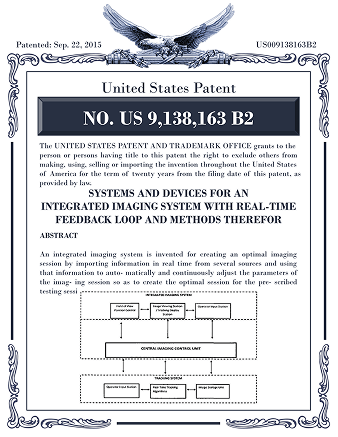
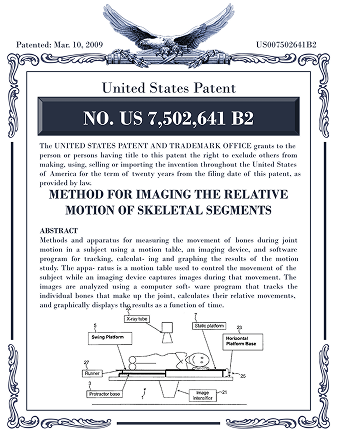
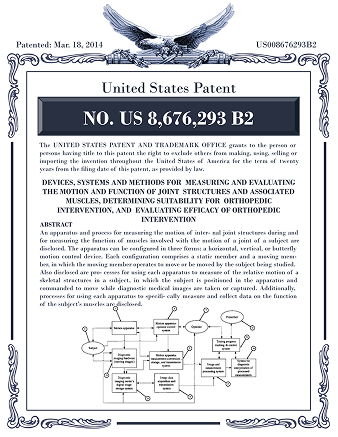
Patented
Protected by Patented Technology
Lorem ipsum dolor sit amet, consectetur adipiscing elit. Ut elit tellus, luctus nec ullamcorper mattis, pulvinar dapibus leo.
Real-Time Motion Tracking
Patented Precision No Other System Can Legally Match
Your VMA® owns the only patented technology that tracks each vertebra in real time through full ranges of motion.
This means your imaging isn’t guesswork it’s surgical-grade measurement.
What this gives you:
- Objective evidence MRIs and static X-rays cannot show
- Automatic bone tracking that eliminates human error
- Frame-by-frame motion data revealing stiffness, laxity, and paradoxical motion
- Courtroom-ready proof of spinal ligament injury
You’re using the only motion-imaging system that can quantify true segment-level injury and nobody else can legally copy it.
Weight-Bearing Motion Platforms
Patented Technology That Shows Injury Where It Actually Happens
Your patents protect the VMA®’s dynamic platforms engineered to scan the spine under real-life load, in controlled flexion, extension, and side bending.
This exposes injuries that disappear the moment a patient lies still for MRI.
What this gives you:
- True weight-bearing imaging that mirrors daily life
- Identical, reproducible motion arcs for every scan
- Zero operator error during movement
- Reliable evidence of segmental dysfunction and hidden instability
If it doesn’t image the spine under load, it’s not diagnosing the real problem. The VMA® is the only system legally built to do it.
Automated Diagnostic Analysis
Patented Algorithms That Turn Motion Into Objective Injury Proof
The VMA® doesn’t just capture images the patented analysis engine interprets motion, compares it to normative data, and identifies the exact levels that are damaged.
No guesswork. No “interpretation.” Just proof.
What this gives you:
- Segment-specific findings: stiff, lax, unstable, or normal
- Quantifiable ligament injury using real motion data
- Muscle-guarding and soft-tissue involvement insights
- Visual reports attorneys and surgeons immediately understand
These patents turn the VMA® from an imaging device into a full diagnostic system one your competitors can’t imitate or encroach on.
CAse Studies
Explore our Success Stories
From Patient to Advocate to Owner: Building a Motion-Based Imaging Empire
This case study follows a medical entrepreneur whose own injury experience exposed the limitations of static spinal imaging. After years of unanswered questions, a VMA® motion-based spinal assessment provided clarity by evaluating how the spine moved, not just how it appeared at rest. That experience became the catalyst for a larger vision transforming personal insight into an imaging model designed to deliver objective motion measurement, regional placement, and long-term ownership value through dedicated VMA® imaging centers.
- A personal injury experience revealed gaps in how spinal motion was evaluated using conventional imaging alone.
- Access to VMA® motion-based spinal measurement shifted perspective from uncertainty to clarity.
- The journey evolved from patient to advocate to owner, translating lived experience into imaging leadership.
- A single imaging location became the foundation for a scalable, territory-based imaging ownership model.
From Look-Alike Clinic to Differentiated Imaging Asset
This case study features a personal injury clinic owner who recognized that steady growth alone was not enough to build a durable, valuable business. Despite strong patient volume, the clinic faced increasing competition, limited differentiation, and no clear long-term exit strategy. By introducing motion-based spinal imaging and owning a proprietary diagnostic capability within a defined region, the practice transitioned from a service-based clinic into a differentiated imaging platform designed for scale, margin, and long-term value.
- A successful clinic faced growing competitive pressure and limited differentiation in a crowded personal injury market.
- Imaging ownership was introduced as a strategic shift from commodity services to proprietary diagnostic capability.
- Motion-based imaging created a new revenue stream while repositioning the clinic as a regional diagnostic resource.
- Imaging exclusivity and repeatable scan volume supported long-term valuation and potential exit conversations.
Schedule Your Strategy Session
A strategy session is the next step in determining whether motion-based diagnosis belongs in your practice and how it would be implemented clinically and operationally.
During this session, we evaluate clinical fit, workflow integration, and diagnostic goals to determine whether the VMA® is the right solution for your practice.
Answers made easy, just for you!
Frequently Asked
Questions
Headquartered in Syracuse, NY, with offices throughout the country, we have been servicing clients since 1975.
1 Davis RJ, Lee DC, Wade C, Cheng BC. Measurement Performance of a Computer-Assisted Vertebral Motion Analysis System. International Journal of Spine Surgery. 2015.
2 Davis RJ, Lee DC, Wade C, Cheng BC. Variability in Flexion–Extension Radiographs of the Lumbar Spine: A Comparison of Uncontrolled and Controlled Bending. International Journal of Spine Surgery. 2016.
3 Freeman MD, Katz EA, Rosa SL, Gatterman BG, Strömmer EMF, Leith WM. Diagnostic Accuracy of Videofluoroscopy for Symptomatic Cervical Spine Injury Following Whiplash Trauma. International Journal of Environmental Research and Public Health. 2020.
4 Breen A, Muggleton J, Mellor F. An Objective Spinal Motion Imaging Assessment (OSMIA): Reliability, Accuracy, and Exposure Data. BMC Musculoskeletal Disorders. 2006.
5 Steilen D, Hauser R, Woldin B, Sawyer S. Chronic Neck Pain: Making the Connection Between Capsular Ligament Laxity and Cervical Instability. The Open Orthopaedics Journal. 2014.
6 Tominaga Y, Ndu AB, Coe MP, Ivancic PC, Ito S, Rubin W, Panjabi MM. Neck Ligament Strength Is Decreased Following Whiplash Trauma. BMC Musculoskeletal Disorders. 2006.
7 Liu YK, Tipton CM, Matthes RD, Bedford TG, Maynard JA, Carey RA. Healing of Subfailure Ligament Injury: A Comparison Between Immature and Mature Ligaments in a Rat Model. Journal of Orthopaedic Research. 1989.
8 Ivancic PC, Ito S, Tominaga Y, Rubin W, Coe MP, Ndu A, Carlson EJ, Panjabi MM. Whiplash Causes Increased Laxity of Cervical Capsular Ligament. Clinical Biomechanics. 2008.
9 Cholewicki J, McGill S, Wells R, Vernon H. Method for Measuring Vertebral Kinematics From Videofluoroscopy. Clinical Biomechanics. 1991.
MRI and standard X-ray evaluate the spine at rest often in a non–weight-bearing, supine position. The VMA® analyzes spinal motion while the patient is upright and weight-bearing, capturing how the spine actually functions in daily life. This allows ligament instability to be identified and quantified in a way static or non–weight-bearing imaging cannot reliably achieve.

Yes. The VMA® is designed to integrate into established clinical workflows with minimal disruption. Our team supports setup, reporting, and interpretation so the diagnostic process complements not complicates your practice.
All VMA® studies are independently reviewed and signed by board-certified radiologists. This separation ensures clinical credibility and supports use in treatment planning, insurance review, and med-legal contexts.
The strategy session is a focused, professional discussion to determine clinical fit, diagnostic goals, and operational considerations. It’s designed to clarify whether motion-based diagnosis is appropriate for your practice before any decisions are made.